Short stories, flash fiction, and creative essays. Follow for my latest horror and scifi pieces, as well as updates on my novel series and comic projects.
It’s Monday evening (as I write this) and the end of a long day. Ice drapes over everything, but it’s about 20-30 degrees warmer than it has been, so I take it as a win.
My brain is tired. Emotions weigh heavy, but I’m here. I have a draft of my next novel open on my desktop, and there’s fire burning within to crank out another chapter or two. Last week, I knocked out my first newsletter of 2026, and I’m already itching for the next one.
A couple of years ago, I posted about forcing myself to write on my phone. Part of the goal was to capture those thoughts that pop to mind throughout the other day. I also wanted to make use of the downtime that pops up sporadically throughout the day (15 minutes here, 10 minutes). Why? Because keeping that torch of creativity lit during busy work-weeks while juggling family obligations and errands is no easy feat.
I have creative friends who set aside an hour each day to write. I know others who are weekend warriors. For myself, I write whenever I can fit it in. Sometimes it’s on weeknights. When I’m lucky, I carve out some time in the morning or during lunch at the office.
But I found something, friends. I plunked down an easy $10 on a bluetooth keyboard I found in the wild at our local Aldi (of all places). It’s foldable and is about the same size as my smartphone.
Monday, 10:04 AM Bob rearranged the foil candy wrappers into a neat stack on his desk for the second time. On his computer monitor, an AI chatbot wrote an email response that Bob would copy and paste into a draft saved in his inbox. When the script finished, Bob quickly scanned the text for any glaring errors, then pasted it into an email draft with the subject line: Please upload this to CMS. When Bob clicked send, the email fired off halfway around the world to an ever-expanding part-time office in the Philippines.
After confirming that the email was sent, Bob pulled out his smartphone and scrolled social media. A sweating man with a bulging vein ranted about a kids movie at the top of his feed. Beneath that, Bob’s aunt posted an awkward photo of her standing in front of a mirror at the gym. This was followed by an inflammatory article about the potential risks tortilla chips pose for dental health. Bob opened his camera, switched to selfie mode, and rooted around in his mouth with an unwashed index finger. His yellow, coffee-stained teeth looked the same as they did six months ago, and his gums also appeared unchanged since he last rubbed a grimy finger over them.
Satisfied, Bob opened the drawer on his office desk and rummaged through a sea of empty chip bags. His hand returned empty. Looking to the left, then the right, Bob stood up from his worn office chair. The smell of ass sweat wafted from the seat, and Bob carefully slid his legs out in order to air out. On the TV across the room, a ticker tape ran below the newsfeed that read: Both candidates call for cooler political rhetoric and national unity.
Bob stretched his arms over his head, gave his bulbous-eyed, blonde colleague with the gopher teeth a nod, and then followed the sewer brown carpet toward the front of the office. Most of the cubes stood empty, faded memories of coworkers whose jobs had been shipped overseas. A crinkled agenda lingered here. A pink motivational post-it note still stood firmly there.
“I want a donut,” Bob announced to no one in particular.
When I was a little guy, I was both mischievous and an ardent rule-follower. That sounds like an oxymoron, but there’s truth in it. I enjoyed bending or breaking rules when I found a way to circumvent them. I’d stay up late on a school night reading or playing video games, then steal back some lost sleep with micro naps in class. When Star Wars: Episode III — The Revenge of the Sith premiered in 2005, I cut class with a few friends, and we spent the afternoon at the movie theater. This was far from the only time I flaked on important opportunities in lieu of fun, and as I grew, I found creative ways to skirt the “way things are supposed to be” for mischief.
At the same time, I was strict about which principles or rules I followed. Because storytelling was so important to me at a young age, I was a devout believer that there was an order to art and creativity, that there were laws that weren’t supposed to be broken. Vampires were warded off by garlic and avoided sunlight for fear of death. Silver bullets were the main method of dealing with werewolves. That sort of thing.
It sounds silly to think of myself as a child who was comfortable with skirting social expectations and norms but consumed books, movies, and comics with such rigidity. But this is also something that’s so very human. It’s a dichotomy we all carry with us in one way or another.
Eventually, I dropped the rigidity when it came to art and creativity. It came about in the most unexpected way. I watched a vampire flick called Innocent Blood, wherein an empathetic “good” vampire had to slay nefarious mobster vampires who were turning New York City into their playground. She did so with a gun, and the “bad” vampires were killed by destroying their brains. As much as it was fun, my brain couldn’t process rules normally reserved for ghouls or the living dead being applied to vampires here—two distinctly different monster types.
We live in strange, frightening times. Many of our most vulnerable populations are at risk simply because they ask for the right to exist. Assistance programs, resources, and educational assets like museums, libraries, and cultural centers are on the chopping block. What many of us consider “civilization” is teetering over the edge, plunging us into a warped reality that’s being advertised to us as “greatness.”
We write our representatives. We help each other out. We rebel in small ways, including where we decide to vote with our dollars. In the indie publishing/writing community, many readers and fellow creatives have decided to stand their ground and choose NOT to shop at Amazon. I consider myself among them.
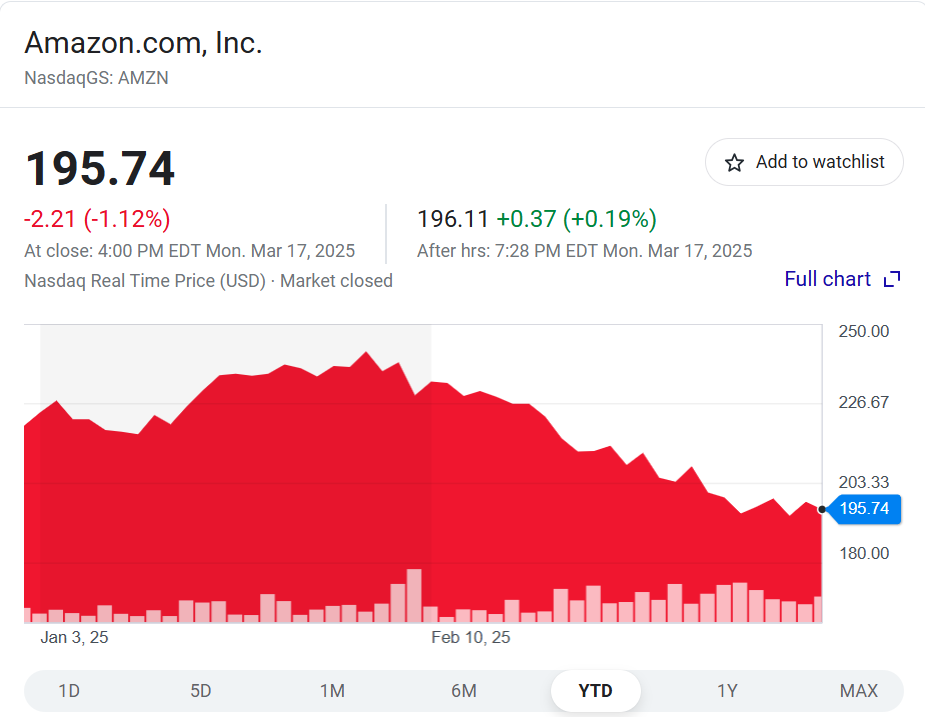
This seemingly simple protest vote has been effective, it would seem, especially when it comes at a time when tariffs are applied and revised inconsistently. As I write this, Amazon has been declining since early February, and it’s lower than it’s ever been year-to-date.
As more readers hold strong, choosing to shop directly from businesses instead of a marketplace platform, having an ebook on Kindle becomes more challenging.
Luckily, a reader of mine turned me onto a platform called Itch.io. It’s geared toward younger readers, gamers, and niche communities, but it’s also home to a thriving ebook author community.
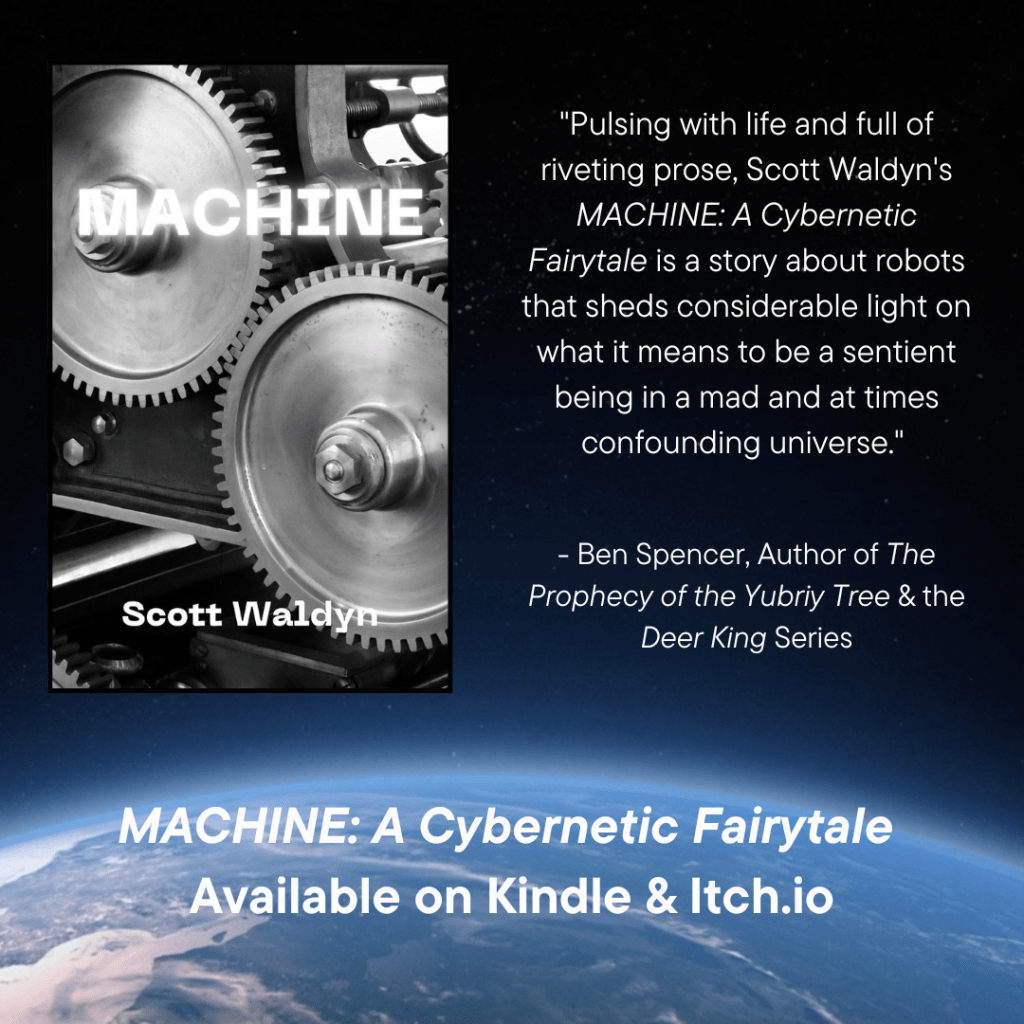
I’ve since added my novel, MACHINE: A Cybernetic Fairytale, to the platform. Because I make more with each purchase on Itch.io, I’ve also lowered the price on this platform. What was $8.99 on Amazon is now a cool, easy-breezy $4.99 on Itch.io. It’s never been a better time to check out the first in a new series of mine.
If you are unable to purchase my ebook and still want to show your support, considering sharing the link. For those who have read it, any and all reviews and feedback are welcome. Even if you hate it.
“Feet-all-Al-Coal-Hall-Sin-Drum,” Alan sounded out. “That’s what my mom and dad said you have.” He jabbed his finger into the cool spring air to emphasize the point, just in case his furrowed brows and trembling lips failed to convey anger.
“What does that EVEN MEAN?” Markie fired back. His voice was raspy. He smelled like stale cereal. The tangled fluff of red hair atop his head was lopsided and bunched up to one side, and his freckles were gross. And Markie swore. The fear of God hadn’t touched him the way it had the others, hadn’t stirred in him the wrathful revelation, rendering him free to utter syllables no one else dare speak. One time, in front of the teacher, he even blurted out, “Shit!”
“It means you’re a jerk. That’s what it means!”
It was true. Markie was a jerk. He was the meanest jerk on the playground, and he’d bully kids on a whim. Everybody used to shy away from him at recess, so he’d have to conscript his “friends,” demanding to join their games in lieu of school-wide humiliation. And he wasn’t afraid of hitting to get his way. This was why the boys were afraid of him; it was why the girls hid from Markie.
Oh, the girls, Alan mused. Just entertaining the thought of ladies filled his mind with daydreams teeming with wet kisses and bony fingers wrapped tightly around his midsection. He imagined soft chins gently nuzzling a single hair taped to his smooth chest. It didn’t matter from which girl or for how long or if she had milk or peanut butter breath. Alan just wanted kisses. He wanted to be the lip-smeared hero from all of his videogames, defying all odds and manner of foes to collect puckered smooches from the fairer sex.
“You want to take that to your grave?” Markie loomed over the would-be hero like a ruby-freckled goliath, his broad shoulders rippling with visible muscles under that Van Halen T-shirt. His Neanderthal forehead creased as he drilled his right fist into his left palm. The resulting sound reminded Alan of a handsaw chewing through lumber. Slowly. Painfully.
When a tree is sawn in half in a forest, and nobody is around…
“I’m a meat-eater, chicken shit, and you’re the meat,” the barbarian growled. An inhuman growl. The kind of throaty growl that reminded Alan of the second boss in that Sega Genesis game he unwrapped last Christmas – Joe & Mac. It’s true; Markie lacked the flailing vines and the leafy mouth of the gargantuan, man-eating plant, but their bellows were nearly identical – ominous and pitched in the wrathful, revelatory octaves of Hell.
It took Alan and his brother, Greg, three tries before they cleared the second level, three tries before they discovered the perfect combination of stone boulders and boomerangs that would pummel that prehistoric flora back into the dirt. And when they finally mashed their fingers to victory, mugs of eggnog, the Christmas elixir of 16-bit champions, never tasted so sweet.
But even sweeter were the kisses. The spoils of war. The prizes of valor. With each boss slain, a voluptuous cavewoman would jog onto the screen, seeking out the hero who dealt the most damage. She’d kiss this loincloth-wearing champion – long and hard – for half a second. His life meter at the top of the screen refilled, he’d raise his arms in victory, standing next to his untouched brother, whose head bowed in shame. For only one could unlock the sensation of puffy-lip smooches. Only one could boast the lecherous treasures of courageous conquests at the caveman bar.
And each time he shamed his brother, Alan would watch in awe. His gleeful voyeurism lapped up the adventures of his digital Casanova, scribbling mental notes. There must have been damsels everywhere, inexplicably thrust into wanton captivity.
It was the year I was promoted from a specialist to an account manager with the digital marketing agency I work for, meaning more responsibility as well as more freedom to assess clients’ needs and come up with a plan of action.
2024 was also the year where, creatively, I had to reassess where I put my time and efforts. I had to learn to say no and walk away from certain tasks if I wanted to say yes or carve out more writing time for myself, as well as time to spend with family, friends, and, most importantly, my wife.
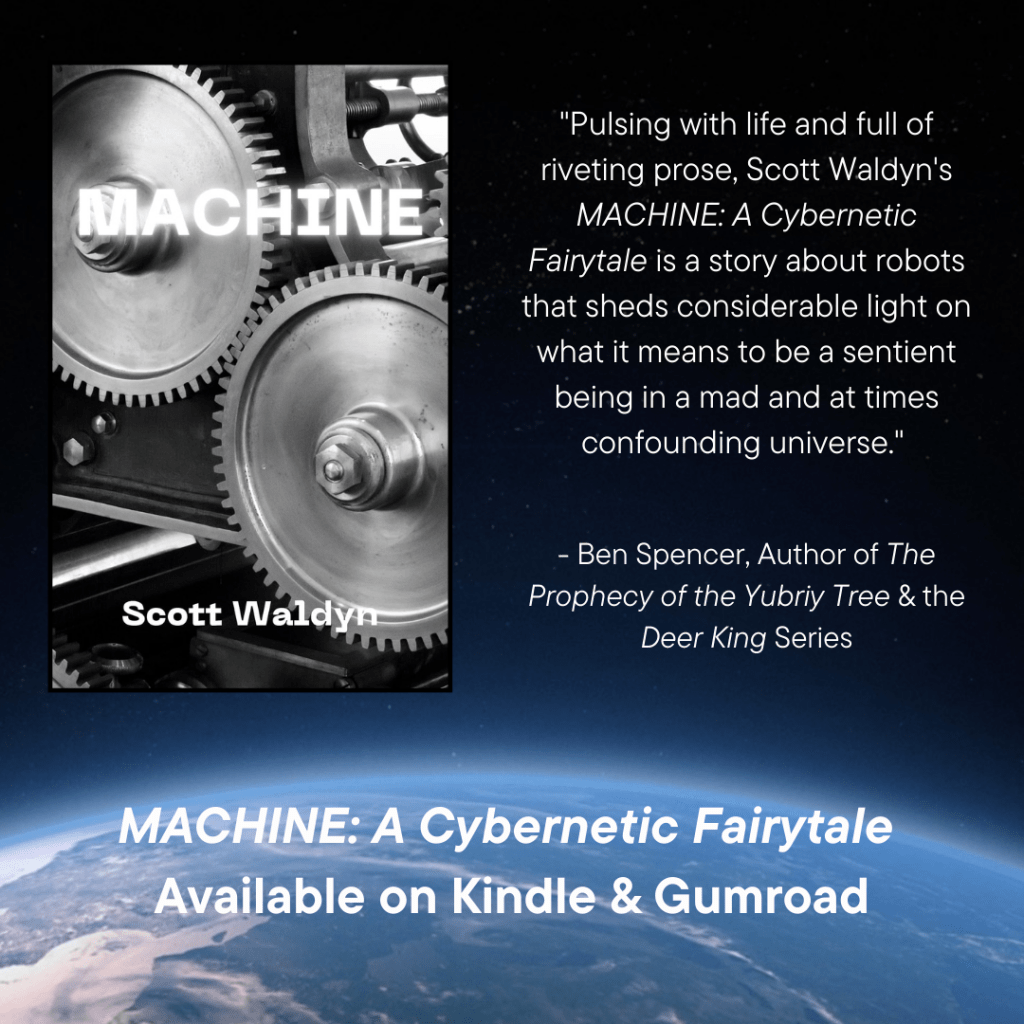
It was also the year where I finally released MACHINE: A Cybernetic Fairytale, a book I had been writing and talking about off and on for several years now. After much trial and error querying publishers and agents, I decided to release it independently. MACHINE: A Cybernetic Fairytale is digitally available for purchase on Amazon Kindle or Gumroad. It’s also part of Kindle Unlimited, so you can read it for free (and leave a rating/review).
My robot novella, MACHINE: A Cybernetic Fairytale, is available as an ebook. For those of you who have been following me for a while, this is a long-time coming. For newcomers who are fans of my comic book reviews, short stories, Substack newsletter, or podcast interviews, I’ve been tinkering and shopping MACHINE around for years now, and I’d be thrilled if you would read it and share your thoughts.
What’s it about?
Meet Rocket Pal Model 5.624 (“Rocket” for short). Despite his strongest efforts, his yearning and best attempts at self-termination are thwarted at every turn. Luckily for Rocket, his continued survival in a repugnant civilization teeming with humans who couldn’t care less for machines leads this bot on a journey of exploration and self-discovery. From joining a robot rebellion to finding itself at odds with both human villains intent on subjugating Rocket and a self-aware, vengeful rebellion leader who adopts the moniker of its former owners, Rocket computes the meaning of perseverance and what makes humans persist. No longer obsessed with its own destruction, Rocket works to overcome its enemies, fully realizing that we all have value — human and machine — and the capacity for good.
In short, it’s a science fiction odyssey about a suicidal robot. At its core, it’s about a feeling many of us have when we look in the mirror, and it’s a book written for those who have struggled (or currently are struggling) with suicide-ideation. The world’s a big place, and it’s easy to get lost in the shuffle of daily challenges, social strife, bad news, and everything else that leaves us feeling lost and hollow. Though a machine, Rocket is emblematic of anyone who has ever felt these negative feelings. He’s a champion for us all, a rallying call that could, perhaps, help us lift ourselves out of the rut.
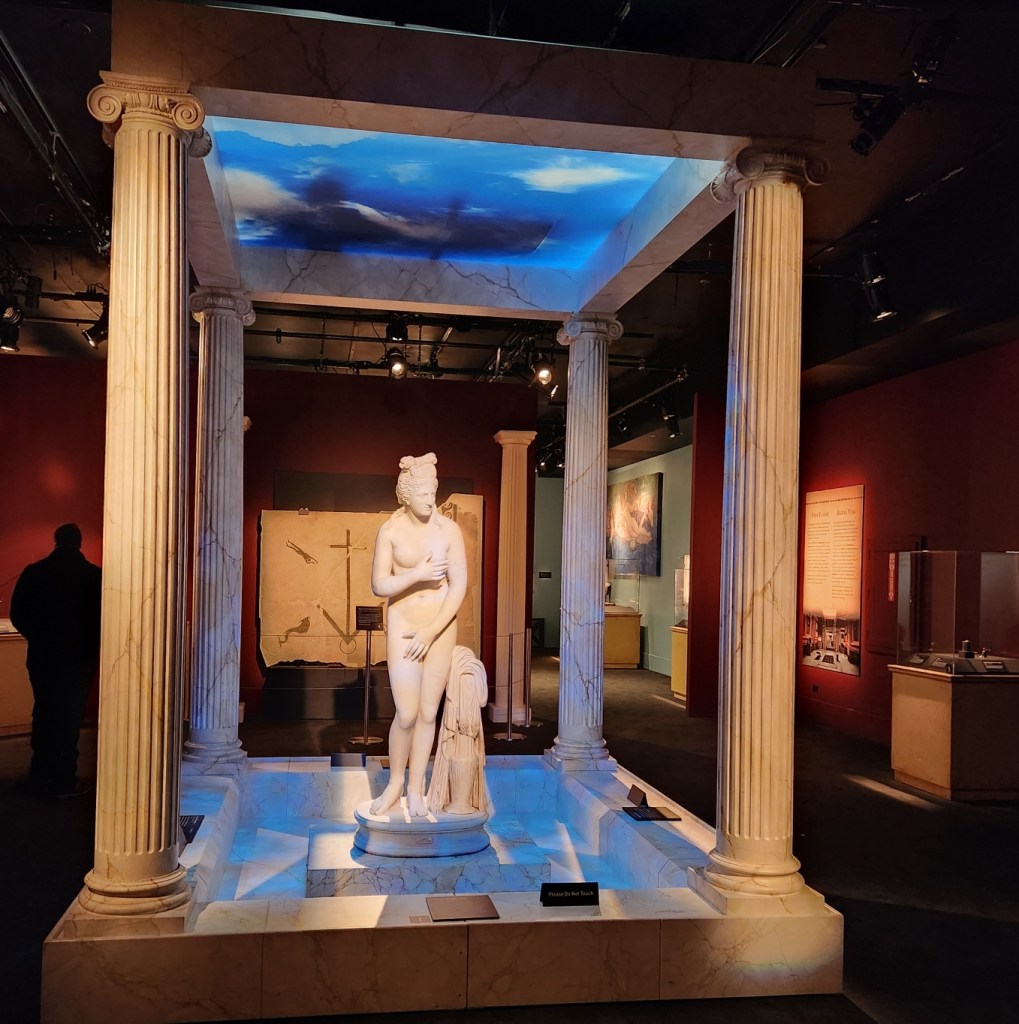
My wife and I recently explored an exhibit on Pompeii at the Museum of Science & Industry in Chicago. It was fascinating, broken up into two parts: What we know of Pompeii before Mt. Vesuvius’ eruption and the aftermath.
The artifacts on display were beautiful, paired with reproductions that simulated life at the time. The first half of the exhibit walked through Pompeii as a port city that flourished from the export of garum (a fish salt used in everything).
Because it’s the Museum of Science of Industry, there was focus on ancient Roman architecture and how thoughtfully designed it was. For those who don’t know, much of what we know about ancient Roman life also comes from the archaeological exploration of Pompeii’s ruins.
Leading into the second-half of the exhibit, there was a simulation of Mt. Vesuvius’ eruption, with time stamps detailing the waves the emanated from the volcano within a 24-hour period, and how it buried Pompeii with toxic gas, ash, and debris. The plaster casts made from holes in the solidified rock where bodies once were are what remains of the city’s people. Each one is mortifying. On some, you can even see faces preserved in anguish and horror.
The discovery of Pompeii influenced the creation of the field of archaeology. From this tragedy, this city literally buried and wiped off from the face of the planet, much was preserved for study centuries later.
What resonated with me most was how similar society seemed. Styles, technology, and architecture were different, but daily Pompeiians went about their business like we do. They ate out, put up pictures on the wall, socialized with a shared bottle, shopped at the weekly market on the public square, littered buildings with graffiti, and let the dog out into the yard. Irate citizens carved bad reviews into the walls of public buildings. Wealthy business owners lived in ancient McMansions while lower income Pompeiians lived in apartment-style dwellings.
Like any society before or since, they dreamed and created works of art – both beautiful frescoes for public display and lurid paintings for brothels and secret kink rooms. As I said before, style, technology, and architecture changed, but humanity has remained humanity.
We evolve. Our laws tend to arc more humanistic, but that need for human connection remains the same. We love to socialize, to share our top ten lists or let others know when takeout was subpar. The public square, forum, townhall, or whatever we want to call it, will always be there in some form, whether that’s digital or concrete.
It’s integral to us, and we are who we are. We see the same themes come up in our stories over and over again. Themes like greed, love, passion, and desires for acceptance and liberty are timeless.
I suppose it says a lot that a good chunk of the exhibit focused on daily life, and it says even more that I fixated on the similarities, the human connection through time. What happened to Pompeii was tragic and devastating, and maybe that sense of loss is amplified by understanding the little things that make up humanity, the needs, wants, and desires.
Between all of our reading apps, streaming services, blogs, vlogs, books, movies, TV shows, etc., we’re adrift in a sea of entertainment constantly begging for attention. On paper, it’s a gift for people searching for entertainment, granting the opportunity to pick and choose what to engage with. The flip side, however, can doom viewers to spending hours scrolling through “content.”
As creators, being chosen in this ocean of entertainment is extremely challenging. Getting eyeballs or interactions is something of a game, involving the pursuit of a following and engaging with fans and others in the hopes that they’ll engage back. Unlike large companies, who rely on recognized brand identities to do the heavy lifting, individual creators often have to tie their efforts to a particular fan community or get creative in coaxing entertainment-seekers to give them just a few seconds of time.
In the evolution of this weird world of entertainment we find ourselves in, we let a particular word take center stage, and it irks me. It’s a marketing word, but as both creators and fans, we’ve permitted its continued existence. It’s not uncommon to hear people reference things like “streaming content” or “blog content.” There even exists a group of creative people labeled as “content creators,” and their job is to get in front of the camera everyday to produce what even they label as “content.”

 Scott Waldyn Writes