Pompeii

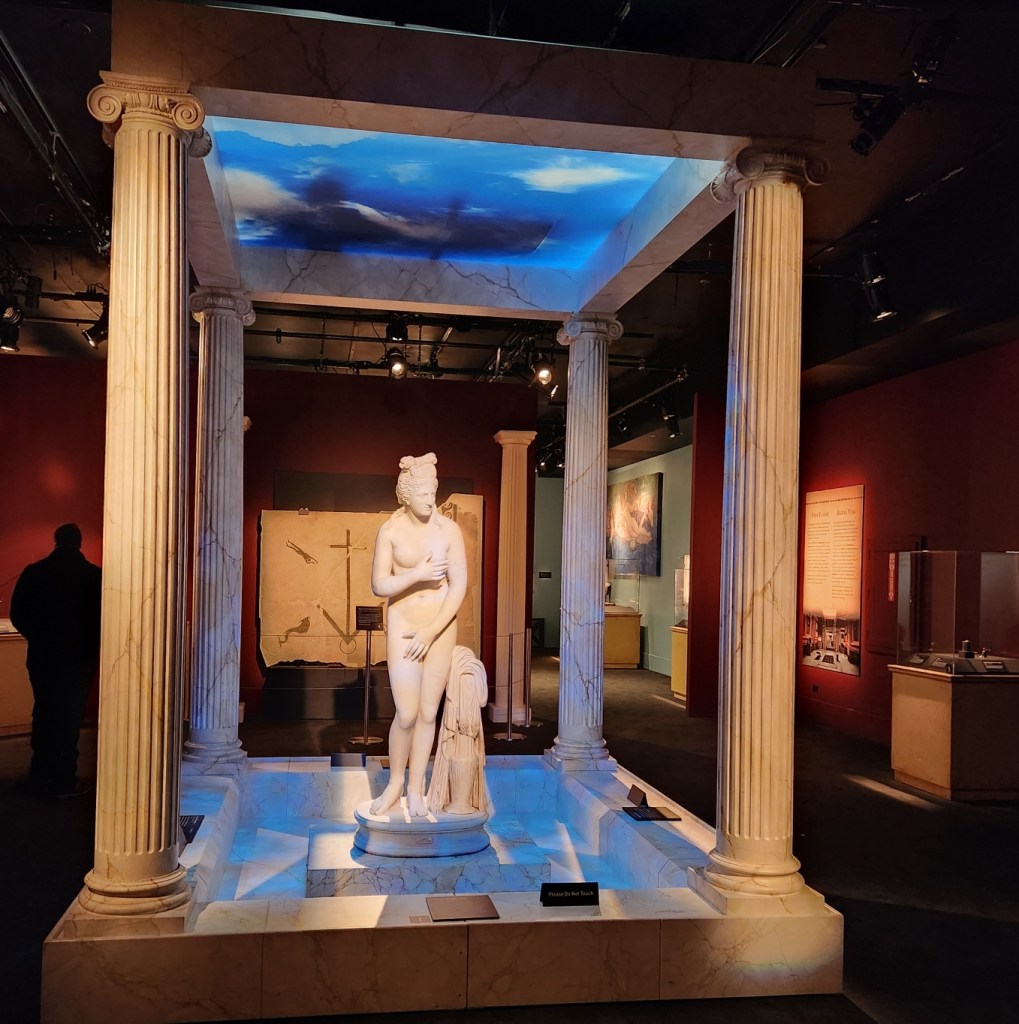
A statue of Aphrodite as part of a museum display.

My wife and I recently explored an exhibit on Pompeii at the Museum of Science & Industry in Chicago. It was fascinating, broken up into two parts: What we know of Pompeii before Mt. Vesuvius’ eruption and the aftermath.

The artifacts on display were beautiful, paired with reproductions that simulated life at the time. The first half of the exhibit walked through Pompeii as a port city that flourished from the export of garum (a fish salt used in everything).

Because it’s the Museum of Science of Industry, there was focus on ancient Roman architecture and how thoughtfully designed it was. For those who don’t know, much of what we know about ancient Roman life also comes from the archaeological exploration of Pompeii’s ruins.

Leading into the second-half of the exhibit, there was a simulation of Mt. Vesuvius’ eruption, with time stamps detailing the waves the emanated from the volcano within a 24-hour period, and how it buried Pompeii with toxic gas, ash, and debris. The plaster casts made from holes in the solidified rock where bodies once were are what remains of the city’s people. Each one is mortifying. On some, you can even see faces preserved in anguish and horror.

The discovery of Pompeii influenced the creation of the field of archaeology. From this tragedy, this city literally buried and wiped off from the face of the planet, much was preserved for study centuries later.

What resonated with me most was how similar society seemed. Styles, technology, and architecture were different, but daily Pompeiians went about their business like we do. They ate out, put up pictures on the wall, socialized with a shared bottle, shopped at the weekly market on the public square, littered buildings with graffiti, and let the dog out into the yard. Irate citizens carved bad reviews into the walls of public buildings. Wealthy business owners lived in ancient McMansions while lower income Pompeiians lived in apartment-style dwellings.

Like any society before or since, they dreamed and created works of art – both beautiful frescoes for public display and lurid paintings for brothels and secret kink rooms. As I said before, style, technology, and architecture changed, but humanity has remained humanity.

We evolve. Our laws tend to arc more humanistic, but that need for human connection remains the same. We love to socialize, to share our top ten lists or let others know when takeout was subpar. The public square, forum, townhall, or whatever we want to call it, will always be there in some form, whether that’s digital or concrete.

It’s integral to us, and we are who we are. We see the same themes come up in our stories over and over again. Themes like greed, love, passion, and desires for acceptance and liberty are timeless.

I suppose it says a lot that a good chunk of the exhibit focused on daily life, and it says even more that I fixated on the similarities, the human connection through time. What happened to Pompeii was tragic and devastating, and maybe that sense of loss is amplified by understanding the little things that make up humanity, the needs, wants, and desires.

Don’t Call It “Content”

Between all of our reading apps, streaming services, blogs, vlogs, books, movies, TV shows, etc., we’re adrift in a sea of entertainment constantly begging for attention. On paper, it’s a gift for people searching for entertainment, granting the opportunity to pick and choose what to engage with. The flip side, however, can doom viewers to spending hours scrolling through “content.”

As creators, being chosen in this ocean of entertainment is extremely challenging. Getting eyeballs or interactions is something of a game, involving the pursuit of a following and engaging with fans and others in the hopes that they’ll engage back. Unlike large companies, who rely on recognized brand identities to do the heavy lifting, individual creators often have to tie their efforts to a particular fan community or get creative in coaxing entertainment-seekers to give them just a few seconds of time. 

In the evolution of this weird world of entertainment we find ourselves in, we let a particular word take center stage, and it irks me. It’s a marketing word, but as both creators and fans, we’ve permitted its continued existence. It’s not uncommon to hear people reference things like “streaming content” or “blog content.” There even exists a group of creative people labeled as “content creators,” and their job is to get in front of the camera everyday to produce what even they label as “content.” 

Continue reading

I’m Training My Dumb Fingers to Get Used to Writing on My Phone

One of the biggest barriers to me writing these days is that I have to sit down at a laptop, open it up, type in my password, pull up my writing applications, and just start typing away from a stationary location. In order to do this, I also need to make sure there are no fires to put out, no chores or errands to run, no people to respond to, no pernicious cats to bestow my attention upon, and check my calendar for any pre-scheduled date nights with my wife. 

I assume it was as exhausting to read all of that word-vomit as it was to write it out. 

Because it’s such a chore to check off everything listed out above (and make a piping hot cup of tea, which I simply must have when writing), I’ve been avoiding writing more than I’d like lately. Sure, I knock out all of my comic book reviews over at TheBatmanUniverse.net. I also am pretty active with the TBU podcast, and I’ve gotten into a good groove with Because We Can. But my own personal writing on short stories and the novel? Nah, man. I’ve been slacking. 

To help chew through the barriers and force myself to get a few words in whenever I get a minute, I’ve been training my brain to use my phone. For many of you, this is probably a no-brainer and a slam dunk. I know for writers who are also parents, finding time and space to write is a godsend, and they take it where they can get it. 

But I’ve always hated the idea of mashing my stupid, fat fingers on my phone. The screen’s too small, and my fingers are like giant worms lazily brushing up against the keypad, hitting two or three letters with each tap. Garbage spews out, and I have to tap that backspace repeatedly.

 Though I feel it’s harder to type on my phone, in a world where I might be able to eek out five minutes here, 10 minutes there, or maybe 15 minutes waiting for my food to finish cooking — it just makes sense. 

So I’ve been training. I’ve smiled through the pain. I’ve slowed down my mashing and worked on my aim. The taps come more slowly, but my accuracy is improving. Typing on my phone also means I hyperventilate over a word choice and edit less, as it’s way harder to edit on mobile than it is on a real computer. 

It’s working… so far. But I do miss the clickety-clack of the laptop though. The phone just doesn’t sound the same. 

The Long Goodbye (I Quit Twitter)

A little over a month back, I quit Twitter. It had been some months in the making.

I’m not highlighting this to unleash a lengthy rant or decry Twitter’s owner, Elon Musk. You can find those hard-hitting personal essays anywhere. I’m noting this because if you’ve been looking for me on Twitter (or wondering why I’ve been missing), it’s because I terminated my account. 

I’m still around on Discord, Instagram, and at my personal site. While Twitter had been slipping for quite a while, what ultimately drove a stake through my interest in doom-scrolling was when my Substack links and links to my personal website stopped working. At first, it was just Substack, and while I wasn’t happy about it, I was willing to wait it out until Twitter rolled back a rather dumb decision. But then my personal site links broke. 

I was left with no choice but to presume that Elon really hated my writing. First my Substack links wouldn’t work, and then my personal site links broke? It could have been a coincidence, sure, but it’s easier to assume that Elon recoils and seethes at the mention of Night Sky, a story of mine that I believe is an absolute banger (you should read it). 

As mentioned earlier, it’s been over a month. And I don’t feel bad about it. I don’t miss Twitter. I may no longer be hip on pop culture news, but life only improved when I ditched the bird app.

Finding the Groove in Gaps

It’s been a weird month. I just opened up my writing log for only the second time this month. Today, it is May 31, 2023. The last time I entered anything into my log, it was May 1st. In between my last writing session and now, my wife and I suffered a loss in the family. We also hopped on an international flight and took a two-week trip throughout Germany and into Poland. It’s been a few days since our return, and we’re just not finally settling into old grooves. 

I despise long gaps between writing sessions. Even if I only chip away with a few hundred words here or there, the consistency makes me feel accomplished. It reinvigorates my spirit and feels as if life flows through my veins, fingertips, and breath. This has been the longest gap in quite a while, but it’s been a gap overwhelmed with emotion — stress, pain, anguish, love, connection, and self-reflection. 

My wife and I have experienced utter exhaustion and grief, as well as jollity and that epiphanic sensation that comes with discovering something new about yourself. The gap brought us closer together — to each other, as well as with our family. 

Continue reading