‘MACHINE: A Cybernetic Fairytale’ Out Now

It’s out! It’s (finally) out on Amazon!

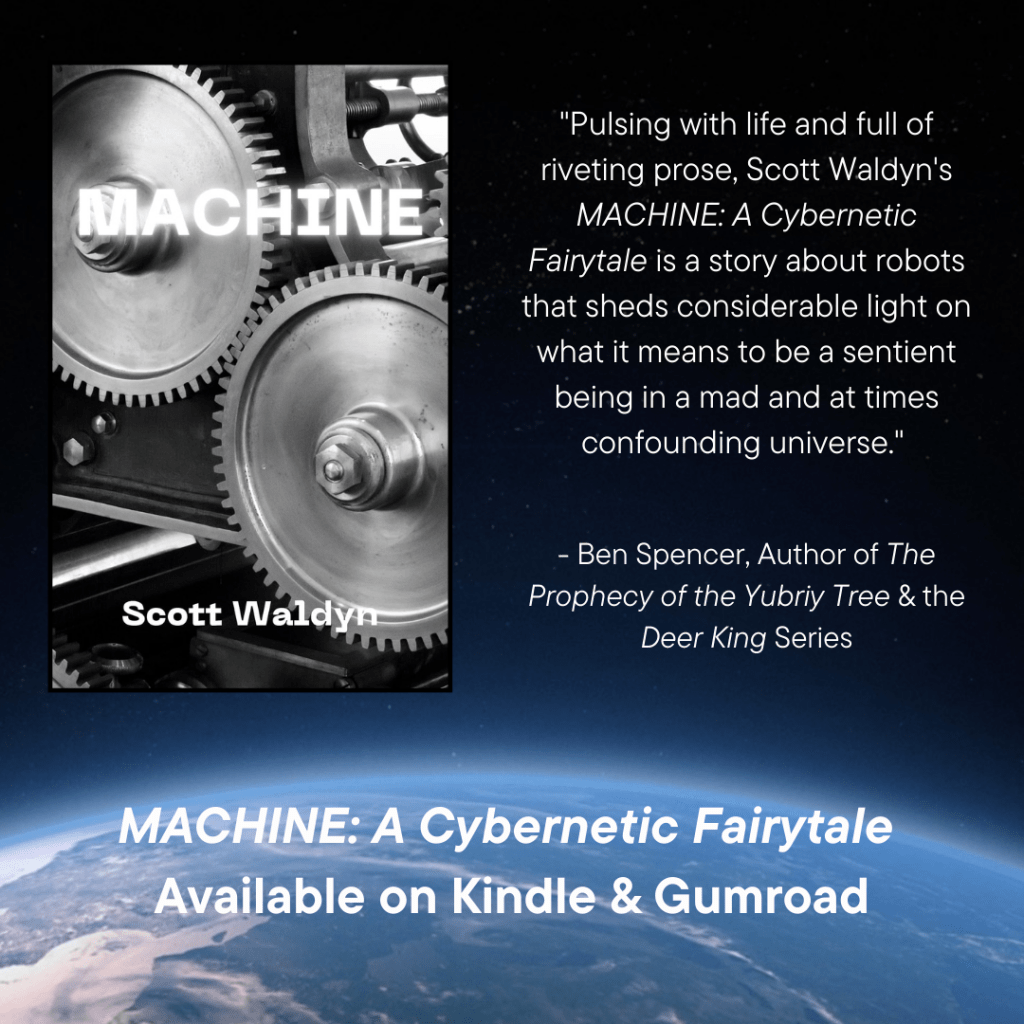
My robot novella, MACHINE: A Cybernetic Fairytale, is available as an ebook. For those of you who have been following me for a while, this is a long-time coming. For newcomers who are fans of my comic book reviews, short stories, Substack newsletter, or podcast interviews, I’ve been tinkering and shopping MACHINE around for years now, and I’d be thrilled if you would read it and share your thoughts.

What’s it about?

Meet Rocket Pal Model 5.624 (“Rocket” for short). Despite his strongest efforts, his yearning and best attempts at self-termination are thwarted at every turn. Luckily for Rocket, his continued survival in a repugnant civilization teeming with humans who couldn’t care less for machines leads this bot on a journey of exploration and self-discovery. From joining a robot rebellion to finding itself at odds with both human villains intent on subjugating Rocket and a self-aware, vengeful rebellion leader who adopts the moniker of its former owners, Rocket computes the meaning of perseverance and what makes humans persist. No longer obsessed with its own destruction, Rocket works to overcome its enemies, fully realizing that we all have value — human and machine — and the capacity for good.

In short, it’s a science fiction odyssey about a suicidal robot. At its core, it’s about a feeling many of us have when we look in the mirror, and it’s a book written for those who have struggled (or currently are struggling) with suicide-ideation. The world’s a big place, and it’s easy to get lost in the shuffle of daily challenges, social strife, bad news, and everything else that leaves us feeling lost and hollow. Though a machine, Rocket is emblematic of anyone who has ever felt these negative feelings. He’s a champion for us all, a rallying call that could, perhaps, help us lift ourselves out of the rut.

Continue reading

Defenders of the Earth Issue 1 – Trying Something New

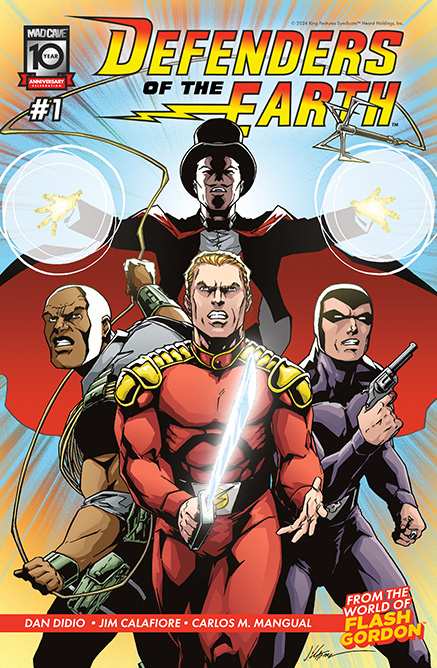
Defenders of the Earth Issue 1 by Dan Didio, Jim Calafiore & Carlos M. Mangual. Image courtesy of Mad Cave Studios.

For about five years (or more) now, I have been writing comic book reviews and podcasting over at TheBatmanUniverse.net. It was a gradual development, starting at first with a review or two, then moving up to editing duties and finally podcasting/interviewing duties. Today, I review anywhere from 2-3 titles per month, host the bi-weekly podcast, and edit a majority of the reviews and content that hits the site. To say it keeps me busy is an understatement.

In the course of getting a feel for the writing of comic book reviews and “chiseling upward” on my podcasting duties, I realized how much of a thrill it is to host a show. Seriously. It’s grown into a creative outlet that’s energizing. Before recording every other week, I get a hit of fear, adrenaline, and excitement all at once. That feeling is tenfold whenever I’ve had the opportunity to interview creators and Bat-fans.

If I’m being honest though, I never set out to be a guy who hosts a podcast. If you asked me several years ago if it was something I ever thought about, I would have told you no. The same can be said for the interviews. Never in my lifetime would I imagine that I’d be emailing comic book creators, Batsuit doubles, movie producers, and more for a chance to talk to them for 45 minutes.

But now that that door has been open, I feel the need to continue my journey and take on a new fear – putting my face in front of the camera.

That led me to Chronicle Chamber, an Australian-based fansite and comprehensive archive devoted to The Phantom. For those unfamiliar with the character, though he was created as American newspaper comic strip character in 1936, he’s seen much larger popularity across the globe than in the United States. An opportunity presented itself to review a State-side revival of the character, and I leaped at the chance.

My first review is attached at the end of the video below. Watch the Youtube clip, or head over to ChronicleChamber.com to see it.

Bear with me as I work the kinks out. As I keep trying out this whole video review thing, I will continue chisel upward. For the second video I just filmed, I already added a ring light tripod to my equipment.

July 2024: What’s the Latest?

It’s been several minutes since my last update. I apologize. These last few months, there have been many irons in many fires, and my time has been limited. When I do have the opportunity to write, it’s either in service of a review or podcast or a few moments to eek out some more words on my sci-fi novella sequel that, for now, I’m just referring to as Bellamy (I’ll post an update in the next few weeks).

As for the first scifi novella (the robot book), unless some publisher scoops it up last-minute, I am planning to release it by the end of the year. It’ll be digital/ebook-only at launch. That doesn’t mean a print edition is out of the picture, it just means one will be coming much later.

Continue reading

5 Movies That Get My Creative Juices Flowing

Some movies make us dream. They may not be the greatest films ever made, but they spark something beautiful within us. These films make us write or draw, paint or build. I’ve written about five movies that get my creative juices flowing without fail. Let me know some of yours in the comments below.


5. Jason and the Argonauts (1963)

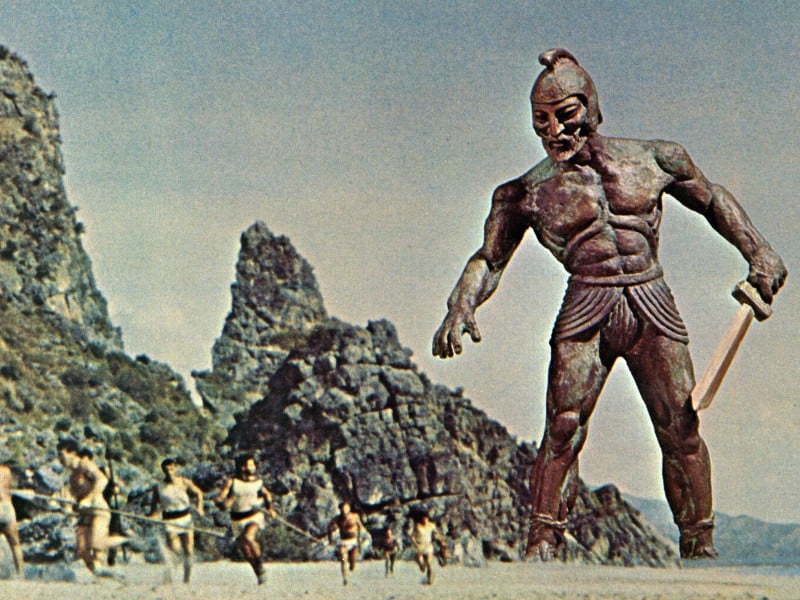
Jason and the Argonauts was one of those grand adventure films I was introduced to at an early age. The thundering soundtrack by Bernard Hermann, the creature designs from Ray Harryhausen, and the globe-trotting scope of Jason’s adventure had, and still does, have such an impact for me.

Though the plot is straightforward, the world Jason and his crew inhabit captures Greek mythology in a way that feels believably ancient and full of magic. It’s lived-in and populated by wild, mythical monsters that, under the skills of Harryhausen, feel so real. I’m not talking about the stop-motion animation, so much as the movements of the creatures. Harryhausen had a way of infusing personality into his monsters, which in turn made them feel all the more realistic, and, oddly enough, human-like.

As a work of art, Jason and the Argonauts takes a classic epic and retells it with passion, bombastic music, and limitless imagination. The scope of its odyssey inspires a sense of wonder that, as a kid, pushed me to take my creativity and run with it.

Continue reading

The Quick February Update

It’s an abnormally warm Sunday in February. The sun’s out, the neighborhood is quiet, and I have a few moments for self-reflection. I wanted to write this “update” last month, but life keeps flying by, each minute faster than the last. 

In 2023, I wrote 58,446 words. That was personal time writing, not day-job writing. It’s about the length of a novel, though it includes short stories, work on one of my book projects, and reviews for TheBatmanUniverse.net. I mentioned in a previous post that I started keeping track of how many words I wrote at the end of 2022 as a form of self-motivation and encouragement. It’s easy to get down about how little you create when you feel like you have nothing to show for it (for example, I have a comic book miniseries, robot novella, and a couple of short stories in need of a good home). However, cataloging the words has helped combat that pessimistic outlook and keep plugging along. 

This year, my goal is to double that number. Currently, I’m tracking at 7,069 words. But that’s not what this update is about.

Since last I posted, my schedule has been busy with family holiday events, new podcast interviews, reviews, and deep thoughts about the future. 

The Quick Updates

  • I interviewed three people for The Batman Universe Podcast in the last month and a half.
    • Robert E. Eliot, author of Nolanverse: Exploring the Greatest Illusion in Movie History.
    • Lou Tambone, editor of The Man Who Laughs: Exploring the Clown Prince of Crime.
    • Ian Miller, creator of the much-beloved fan comic series Batman Enigma.
  • My comic reviews might be expanding outside the realm of Gotham City. I pitched reviewing the upcoming Moonstone The Phantom series to the fine folks at ChronicleChamber.com. For those who don’t know, The Phantom is another one of those comic characters I’ve been a fan of for many years now. 
  • My monthly motivational newsletter Because We Can had its first issue release of 2024
  • I’ve been looking into self-publishing my robot novella, and it’s this last update I wanted to speak to. 
Continue reading

Pompeii

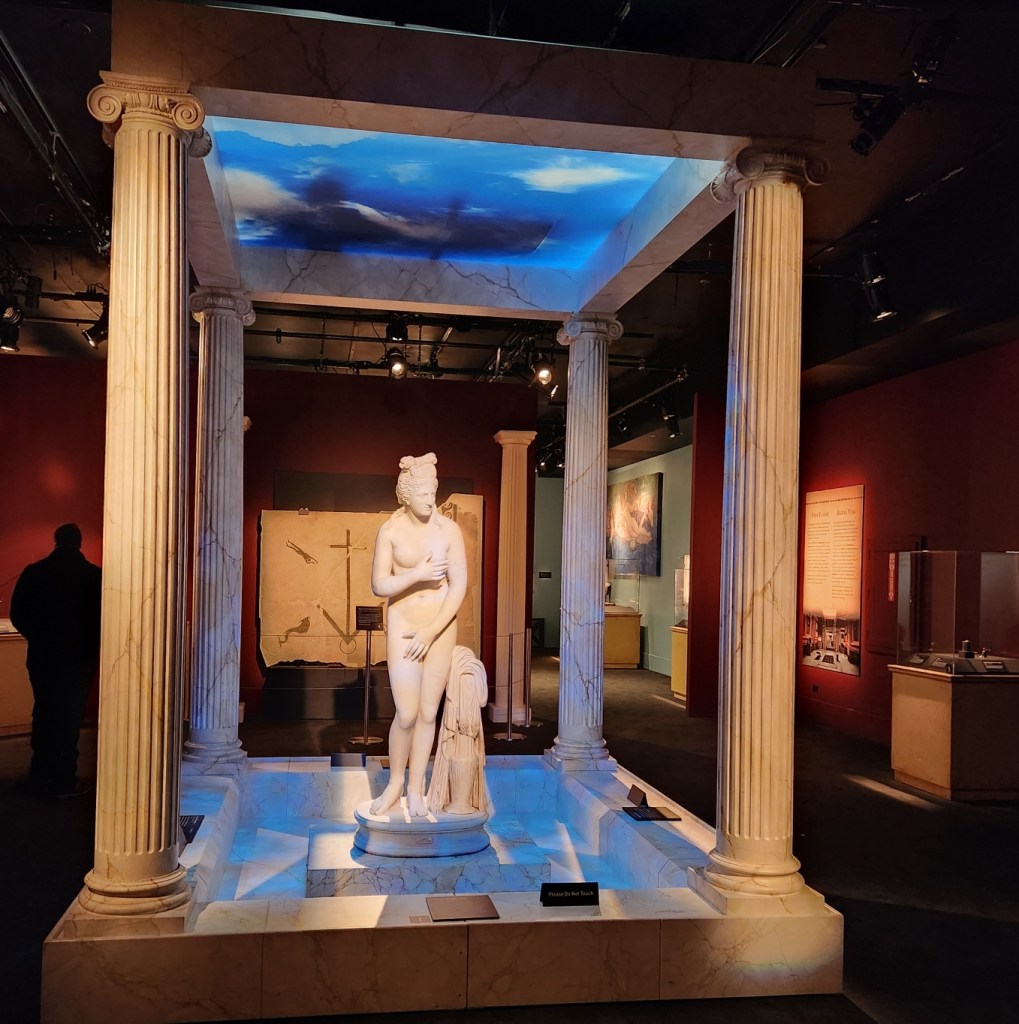
A statue of Aphrodite as part of a museum display.

My wife and I recently explored an exhibit on Pompeii at the Museum of Science & Industry in Chicago. It was fascinating, broken up into two parts: What we know of Pompeii before Mt. Vesuvius’ eruption and the aftermath.

The artifacts on display were beautiful, paired with reproductions that simulated life at the time. The first half of the exhibit walked through Pompeii as a port city that flourished from the export of garum (a fish salt used in everything).

Because it’s the Museum of Science of Industry, there was focus on ancient Roman architecture and how thoughtfully designed it was. For those who don’t know, much of what we know about ancient Roman life also comes from the archaeological exploration of Pompeii’s ruins.

Leading into the second-half of the exhibit, there was a simulation of Mt. Vesuvius’ eruption, with time stamps detailing the waves the emanated from the volcano within a 24-hour period, and how it buried Pompeii with toxic gas, ash, and debris. The plaster casts made from holes in the solidified rock where bodies once were are what remains of the city’s people. Each one is mortifying. On some, you can even see faces preserved in anguish and horror.

The discovery of Pompeii influenced the creation of the field of archaeology. From this tragedy, this city literally buried and wiped off from the face of the planet, much was preserved for study centuries later.

What resonated with me most was how similar society seemed. Styles, technology, and architecture were different, but daily Pompeiians went about their business like we do. They ate out, put up pictures on the wall, socialized with a shared bottle, shopped at the weekly market on the public square, littered buildings with graffiti, and let the dog out into the yard. Irate citizens carved bad reviews into the walls of public buildings. Wealthy business owners lived in ancient McMansions while lower income Pompeiians lived in apartment-style dwellings.

Like any society before or since, they dreamed and created works of art – both beautiful frescoes for public display and lurid paintings for brothels and secret kink rooms. As I said before, style, technology, and architecture changed, but humanity has remained humanity.

We evolve. Our laws tend to arc more humanistic, but that need for human connection remains the same. We love to socialize, to share our top ten lists or let others know when takeout was subpar. The public square, forum, townhall, or whatever we want to call it, will always be there in some form, whether that’s digital or concrete.

It’s integral to us, and we are who we are. We see the same themes come up in our stories over and over again. Themes like greed, love, passion, and desires for acceptance and liberty are timeless.

I suppose it says a lot that a good chunk of the exhibit focused on daily life, and it says even more that I fixated on the similarities, the human connection through time. What happened to Pompeii was tragic and devastating, and maybe that sense of loss is amplified by understanding the little things that make up humanity, the needs, wants, and desires.

Don’t Call It “Content”

Between all of our reading apps, streaming services, blogs, vlogs, books, movies, TV shows, etc., we’re adrift in a sea of entertainment constantly begging for attention. On paper, it’s a gift for people searching for entertainment, granting the opportunity to pick and choose what to engage with. The flip side, however, can doom viewers to spending hours scrolling through “content.”

As creators, being chosen in this ocean of entertainment is extremely challenging. Getting eyeballs or interactions is something of a game, involving the pursuit of a following and engaging with fans and others in the hopes that they’ll engage back. Unlike large companies, who rely on recognized brand identities to do the heavy lifting, individual creators often have to tie their efforts to a particular fan community or get creative in coaxing entertainment-seekers to give them just a few seconds of time. 

In the evolution of this weird world of entertainment we find ourselves in, we let a particular word take center stage, and it irks me. It’s a marketing word, but as both creators and fans, we’ve permitted its continued existence. It’s not uncommon to hear people reference things like “streaming content” or “blog content.” There even exists a group of creative people labeled as “content creators,” and their job is to get in front of the camera everyday to produce what even they label as “content.” 

Continue reading

Short Story: “We’ve Come A Long Way”

Note: This is a republication of a short story of mine that was originally published on Medium. Though more horror-inspired, I’m particularly fond of this piece, as I think it deals with some themes and ideas that have always and will continue to haunt us unless we learn to change our collective mindset and approach to the world around us.

“We’ve come a long way,” Dr. Vannevar said, his beady, sunken eyes fixated on the untamed bringer of war just beyond the viewport. 

Iris didn’t turn her head to look at him, but she could picture Vannevar stroking his little gray beard as he spoke. It was his way of breaking the silence between them, disrupting the descent as their five-person crew approached Mars. Vannevar liked to hear himself talk, so he often made broad observations with an air of scientific inquiry and pretentiousness. Iris wondered if this was how Vannevar talked his way onto this mission, if his sweeping generalizations impressed the executives back home. He certainly hadn’t added anything to the crew since he had come aboard, and Iris wasn’t even sure of what he held a doctorate in. 

As the finer details of Mars grew more pronounced, Iris searched its charmless surface. She wanted to size up the red menace, stare it down as fear settled into her stomach over what, if anything, they would find on the planet. Much like Vannevar’s pedigree, Mars was one giant question mark.  

Members of the Demeter-6 mission were only the second group of scientists (read: “pioneers”) to colonize the planet. The first crew, Demeter-5, had been on Mars for two years now. As of the moment, Demeter-5’s mission status was unknown. Contact had not been made, nor had a signal of any kind been picked up on Demeter-6’s long voyage. For all the crew of Demeter-6 knew, the original colony could have vanished in Mars’ tumultuous desert storms.  

“We’ve come a long way,” Vannevar repeated, this time louder. “From tribal warfare, cannibalism, disease… to this.” 

Iris felt Vannevar’s eyes on her. His hunter’s gaze unsettled her, as if behind the aloof, broadstroke of a personality lie something sinister and predatory. A snake in the grass. Something wriggled beneath her skin, and she hurried to come up with a response that would satisfy Vannevar’s hungry, attention-seeking stare.

“Yes,” Iris said, tugging at the sleeves of her lab coat and hiding beneath loose strands of her wavy, brown hair.

Satiated by her response, Vannevar swiveled his head back toward the viewport. His mouth opened to speak again when a voice erupted through the ship’s intercom.

“We’ve picked up a signal. All crew report to the central command.”

Continue reading

I’m Training My Dumb Fingers to Get Used to Writing on My Phone

One of the biggest barriers to me writing these days is that I have to sit down at a laptop, open it up, type in my password, pull up my writing applications, and just start typing away from a stationary location. In order to do this, I also need to make sure there are no fires to put out, no chores or errands to run, no people to respond to, no pernicious cats to bestow my attention upon, and check my calendar for any pre-scheduled date nights with my wife. 

I assume it was as exhausting to read all of that word-vomit as it was to write it out. 

Because it’s such a chore to check off everything listed out above (and make a piping hot cup of tea, which I simply must have when writing), I’ve been avoiding writing more than I’d like lately. Sure, I knock out all of my comic book reviews over at TheBatmanUniverse.net. I also am pretty active with the TBU podcast, and I’ve gotten into a good groove with Because We Can. But my own personal writing on short stories and the novel? Nah, man. I’ve been slacking. 

To help chew through the barriers and force myself to get a few words in whenever I get a minute, I’ve been training my brain to use my phone. For many of you, this is probably a no-brainer and a slam dunk. I know for writers who are also parents, finding time and space to write is a godsend, and they take it where they can get it. 

But I’ve always hated the idea of mashing my stupid, fat fingers on my phone. The screen’s too small, and my fingers are like giant worms lazily brushing up against the keypad, hitting two or three letters with each tap. Garbage spews out, and I have to tap that backspace repeatedly.

 Though I feel it’s harder to type on my phone, in a world where I might be able to eek out five minutes here, 10 minutes there, or maybe 15 minutes waiting for my food to finish cooking — it just makes sense. 

So I’ve been training. I’ve smiled through the pain. I’ve slowed down my mashing and worked on my aim. The taps come more slowly, but my accuracy is improving. Typing on my phone also means I hyperventilate over a word choice and edit less, as it’s way harder to edit on mobile than it is on a real computer. 

It’s working… so far. But I do miss the clickety-clack of the laptop though. The phone just doesn’t sound the same. 

The Long Goodbye (I Quit Twitter)

A little over a month back, I quit Twitter. It had been some months in the making.

I’m not highlighting this to unleash a lengthy rant or decry Twitter’s owner, Elon Musk. You can find those hard-hitting personal essays anywhere. I’m noting this because if you’ve been looking for me on Twitter (or wondering why I’ve been missing), it’s because I terminated my account. 

I’m still around on Discord, Instagram, and at my personal site. While Twitter had been slipping for quite a while, what ultimately drove a stake through my interest in doom-scrolling was when my Substack links and links to my personal website stopped working. At first, it was just Substack, and while I wasn’t happy about it, I was willing to wait it out until Twitter rolled back a rather dumb decision. But then my personal site links broke. 

I was left with no choice but to presume that Elon really hated my writing. First my Substack links wouldn’t work, and then my personal site links broke? It could have been a coincidence, sure, but it’s easier to assume that Elon recoils and seethes at the mention of Night Sky, a story of mine that I believe is an absolute banger (you should read it). 

As mentioned earlier, it’s been over a month. And I don’t feel bad about it. I don’t miss Twitter. I may no longer be hip on pop culture news, but life only improved when I ditched the bird app.